> ## Documentation Index
> Fetch the complete documentation index at: https://docs.arc.computer/llms.txt
> Use this file to discover all available pages before exploring further.

# GKD Training

> On-policy distillation of Atlas runtime traces using Generalized Knowledge Distillation

## Overview

Generalized Knowledge Distillation (GKD) enables on-policy distillation of Atlas runtime traces into smaller, faster student models. Instead of re-running a full reinforcement-learning cycle, use GKD to compress a reliable teacher checkpoint while staying within the reward-weighted data captured in production.

### Atlas Training Stack Fit

**Problem**: Atlas SDK deployments often produce a reliable teacher policy plus verified runtime traces, yet the teacher checkpoint is too large or costly to redeploy, and running the full SFT → GRPO stack again would add days of compute.

**Solution**: Use GKD to transfer the teacher's action distribution to a smaller student directly from the same on-policy traces, reducing latency while respecting the reward-weighted data collected in production.

**Technical Implementation**: The run config (`src/atlas_core/configs/recipe/teacher_gkd.yaml`) wires the GKD trainer (`src/atlas_core/configs/trainer/gkd.yaml`) and the Postgres-backed dataset builder in `atlas_core.data.gkd`. Trace exports match the schema captured in the [MCP Tool Learning example](/examples/adaptive-tool-use), so you can replay identical workloads through distillation or GRPO. For the reinforcement-learning path, see [`grpo-training.mdx`](./grpo-training.mdx); both flows follow the override patterns documented in the [Training Configuration Guide](../configuration.mdx).

### Data Flow: Runtime to Training

The GKD training pipeline connects runtime traces to trained models:

| Stage                       | Tool                                           | Input                    | Output                     | Time      |
| --------------------------- | ---------------------------------------------- | ------------------------ | -------------------------- | --------- |
| 1. Runtime execution        | `atlas run`                                    | User tasks               | Episode traces in Postgres | Minutes   |
| 2. Export traces (optional) | `arc-atlas`                                    | Postgres episodes        | JSONL dataset              | Minutes   |
| 3. GKD training             | `atlas-core train recipe@_global_=teacher_gkd` | JSONL or Postgres traces | Distilled checkpoint       | 4-8 hours |
| 4. Deploy checkpoint        | Update `teacher_model_name_or_path` in config  | Trained model            | Production teacher         | Minutes   |

<Note>
  **No traces yet?** Run the [Adaptive Tool Use example](/examples/adaptive-tool-use) to generate training data, or see [SDK Export Traces](/sdk/export-traces) to populate your database.
</Note>

<div align="center">
  <img src="https://mintcdn.com/arc-469ffbc2/eFOCTpd4B9R3jMkV/images/system-architecture.png?fit=max&auto=format&n=eFOCTpd4B9R3jMkV&q=85&s=1896b710891b61e62ee4124511950483" alt="Atlas system architecture showing runtime to training flow" width="800" data-path="images/system-architecture.png" />

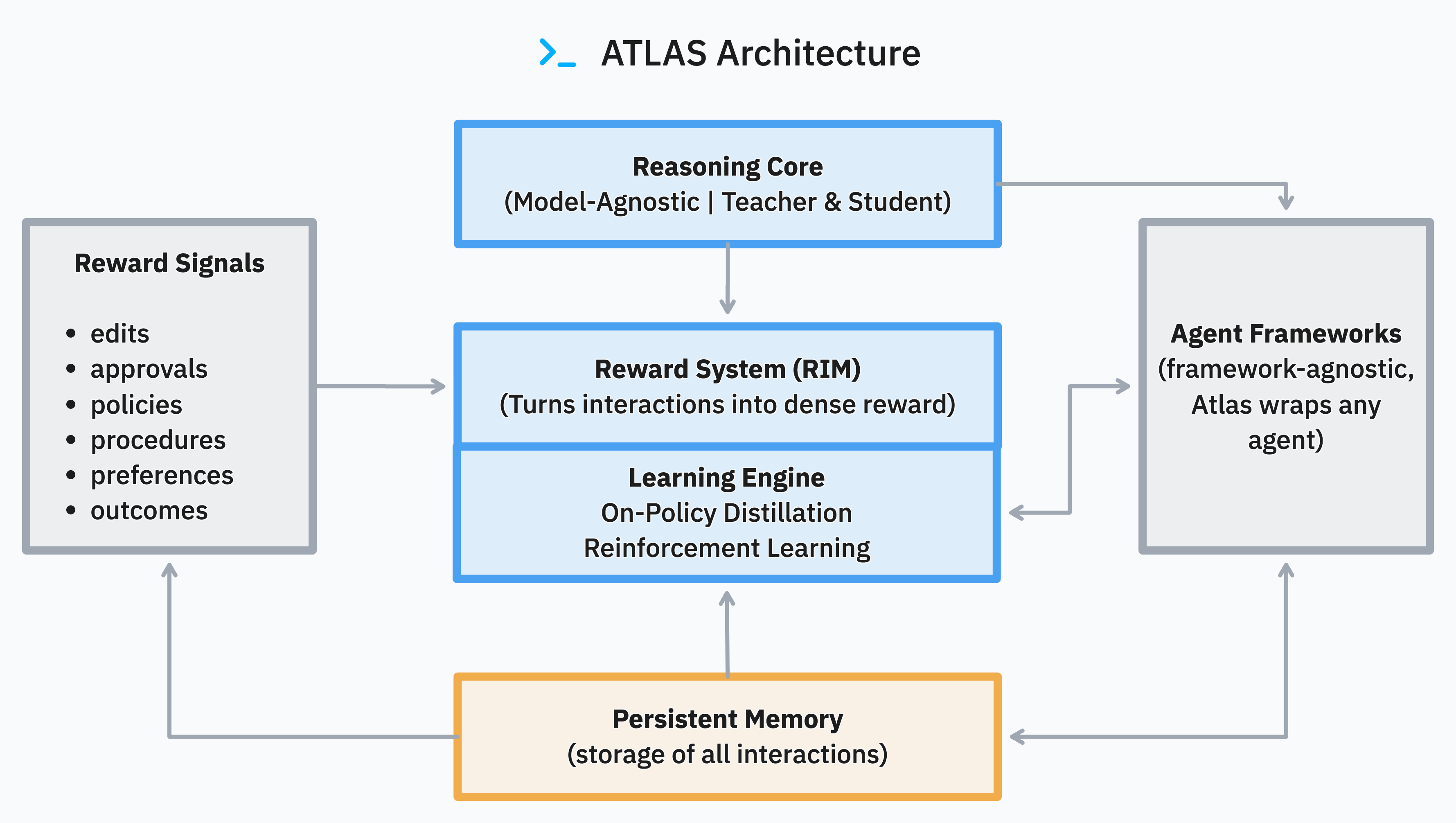
  <p><em>Runtime traces flow from SDK execution to Postgres storage to GKD training to deployed teacher models</em></p>
</div>

### Core Capabilities

GKD handles multi-turn traces directly from Postgres, applies the same tokenization and augmentation stack that GRPO uses, and records baseline-comparison telemetry (success delta and token efficiency) in WandB for side-by-side evaluation with other Atlas trainers. The same Hydra overrides that configure the GRPO pipeline apply here, so swapping between distillation and reinforcement learning becomes a config change rather than a separate code path.

## When to Use GKD vs GRPO

| Criterion         | GKD                       | GRPO                       |
| ----------------- | ------------------------- | -------------------------- |
| **Data source**   | Atlas runtime traces      | Interactive environment    |
| **Compute cost**  | Low (supervised + KL)     | High (PPO + rollouts)      |
| **Speed**         | Fast (single pass)        | Slow (multi-epoch)         |
| **Best for**      | Distill teacher → student | Train from scratch with RL |
| **Training time** | Hours                     | Days                       |

**Rule of thumb**: Use GKD when you have Atlas traces and want to distill knowledge into a smaller model. Use GRPO when training a new policy from scratch via reinforcement learning.

## Quick Start

### Prerequisites

Before running GKD training, verify your environment:

<Steps>
  <Step title="Clone Atlas Core Repository">
    GKD training requires the full Atlas Core repository (not just the SDK):

    ```bash theme={null}
    git clone https://github.com/Arc-Computer/ATLAS.git
    cd ATLAS
    ```
  </Step>

  <Step title="Install Training Dependencies">
    ```bash theme={null}
    # For Python 3.11
    pip install -r requirements-py311.txt

    # For Python 3.12
    pip install -r requirements-py312.txt
    ```

    <Tip>
      This installs PyTorch, TRL, vLLM, and all training dependencies. Takes 10-15 minutes.
    </Tip>
  </Step>

  <Step title="Set Database URL (Optional)">
    GKD training can load traces from Postgres. Set your connection string if using database access:

    ```bash theme={null}
    export ATLAS_DB_URL="postgresql://user:pass@host:5432/atlas"
    ```

    <Note>
      **Using JSONL exports instead?** Skip this step and provide `dataset_path` in your config.
    </Note>
  </Step>

  <Step title="Verify Configuration Files Exist">
    ```bash theme={null}
    # Check required config files
    ls src/atlas_core/configs/recipe/teacher_gkd.yaml
    ls src/atlas_core/configs/trainer/gkd.yaml

    # Expected output:
    # src/atlas_core/configs/recipe/teacher_gkd.yaml
    # src/atlas_core/configs/trainer/gkd.yaml
    ```
  </Step>
</Steps>

### Run First Training Job

Once prerequisites are met, start a minimal GKD run:

```bash theme={null}
# Run from ATLAS repository root
atlas-core train \
  recipe@_global_=teacher_gkd \
  teacher_model_name_or_path=Qwen/Qwen2.5-14B-Instruct \
  model.model_name_or_path=Qwen/Qwen2.5-7B-Instruct \
  trainer.min_reward=0.8 \
  trainer.max_steps=100
```

<Note>
  **First run?** Add `trainer.max_steps=100` to complete a smoke test in 15-20 minutes instead of hours.
</Note>

### Verify Success

**Check training progress:**

```bash theme={null}
tail -f outputs/gkd/training.log | grep "loss:"
```

**Expected output:**

```
{'loss': 1.342, 'learning_rate': 1.9e-05, 'epoch': 0.1}
{'loss': 1.156, 'learning_rate': 1.5e-05, 'epoch': 0.3}
{'loss': 0.892, 'learning_rate': 1.2e-05, 'epoch': 0.6}
# Loss should steadily decrease during training
```

<Note>
  Custom metrics like `metrics/success_delta` and `metrics/token_reduction_pct` are logged to WandB/TensorBoard, not in the console training logs.
</Note>

**Check distillation metrics in WandB:**

* `metrics/success_delta` - Should be positive (student improving over baseline)
* `metrics/token_reduction_pct` - Target: >20% token savings
* `metrics/meets_target` - Should be `true` when both success and token targets met

**Verify checkpoint creation:**

```bash theme={null}
ls -lh outputs/gkd/checkpoint-final/
# Should contain: config.json, model.safetensors, tokenizer files
```

| Metric          | Target        | Meaning                               |
| --------------- | ------------- | ------------------------------------- |
| Training Loss   | \<1.0         | Student learning teacher distribution |
| KL Divergence   | 0.3-0.6       | Balanced teacher/student alignment    |
| Success Delta   | >0 (positive) | Student improves over baseline        |
| Token Reduction | >20%          | Smaller model is more efficient       |

These same Qwen checkpoints (`Qwen/Qwen2.5-14B-Instruct` teacher and `Qwen/Qwen2.5-7B-Instruct` student) are used by `scripts/validate_gkd.py` to measure the GSM8K lift before scaling to customer traces.

Hydra composes the trainer from `src/atlas_core/configs/recipe/teacher_gkd.yaml`, which overrides `_global_.trainer=gkd` and the shared data presets documented in [Training Configuration](../configuration.mdx). Override any field inline (for example `trainer.learning_key`) using the same syntax shown in the GRPO guide.

Running the command streams Atlas runtime traces directly from Postgres (the same database you populate with `arc-atlas --database-url postgresql://... --include-status approved --output traces/runtime.jsonl`), fine-tunes the 7B student to mimic the 14B teacher, logs the Baseline Comparison metrics (success delta and token reduction) to WandB, and writes checkpoints into `outputs/gkd/`. If you prefer to operate on JSONL exports, point the dataset adapter at the CLI output; both paths preserve the SDK schema so Atlas Core sees identical conversation records. For a step-by-step walkthrough of exporting traces, running the validation script, and reading the metrics file, see the [Developer Example: Running GKD](/examples/gkd-dev-example).

### Configuration Files

GKD training uses two main config files. The trainer config (`src/atlas_core/configs/trainer/gkd.yaml`) houses the GKD-specific hyperparameters (lmbda, beta, temperature) plus database connectivity and general training settings. The run config (`src/atlas_core/configs/recipe/teacher_gkd.yaml`) specifies student and teacher checkpoints, the Baseline Comparison reference metrics, and the output/logging targets.

### Cross-Tokenizer Alignment

Issue #45 introduced native support for cross-tokenizer distillation. Two new trainer parameters control the behavior:

* `align_teacher_template` (default: `true`) – when enabled, Atlas captures the raw prompt/completion text for every dataset row, re-renders the conversation with the teacher tokenizer, and computes teacher logprobs in the teacher’s chat template before applying the KL term. Disable it only when the student and teacher share identical tokenizers or when you need to reproduce legacy runs.
* `teacher_tokenizer_name_or_path` (optional) – override when the tokenizer lives at a different path than `teacher_model_name_or_path` (for example, PEFT adapters or custom checkpoints).

The same fields are exposed via `scripts/validate_gkd.py`:

```bash theme={null}
python scripts/validate_gkd.py \
  --teacher-tokenizer Qwen/Qwen2.5-14B-Instruct \
  # ...other args...
  # add --no-align-teacher-template to reproduce legacy behavior
```

By default the validation script aligns templates, so cross-model pairs (e.g., Qwen → Llama) train without the KL spikes caused by mismatched chat formats.

## Key Parameters

### GKD Parameters

#### `lmbda` (On-Policy Fraction)

Set `lmbda` to 1.0 when the student should generate every response and receive teacher guidance token by token; this setting keeps the run fully on-policy and matches the configuration we use for the GSM8K validation sweeps. A mid-range value such as 0.5 mixes teacher- and student-generated continuations when you want to temper exploration, while 0.0 reverts to supervised distillation. Start with 1.0 and only back off when trace quality is noisy or you need consistency with earlier supervised checkpoints (Issue #40 recommendation).

#### `beta` (KL Divergence Balance)

`beta` tunes the interpolation inside the generalized Jensen-Shannon Divergence. Push it toward 0.0 to emphasize the teacher distribution (forward KL), move toward 1.0 to penalize deviations from the student distribution (reverse KL), and stay at the default 0.5 for a balanced view. Start at 0.5, then sweep ±0.2 once you have telemetry on success deltas and token savings.

#### `temperature`

Sampling temperature controls how aggressively the student explores during generation. Values around 0.9 yield more diverse reasoning chains and match the public validation scripts; dropping to 0.5–0.7 tightens answers when traces have deterministic formats. Stick with 0.9 for early runs and lower it only after observing long completions or oscillating eval loss.

### Database Filtering

#### `min_reward`

Minimum session reward threshold for training data:

```yaml theme={null}
trainer:
  min_reward: 0.8  # Only use high-quality traces
```

Higher values (0.8-0.9) ensure training on successful sessions only.

#### `learning_key`

Filter traces by task type:

```yaml theme={null}
trainer:
  learning_key: "crm_workflows"  # Only CRM-related traces
```

Set to `null` to use all traces.

### Baseline Comparison Metrics

Track distillation quality against baseline:

```yaml theme={null}
trainer:
  baseline_success: 0.75     # Baseline task success rate
  baseline_tokens: 1200      # Baseline tokens per episode
```

Atlas logs `metrics/success_delta`, `metrics/token_reduction_pct`, and `metrics/meets_target` alongside loss curves so you can judge whether the distilled checkpoint clears your success and token budgets without exporting separate spreadsheets.

## Example Configurations

### High-Quality Distillation

For maximum quality, use higher reward threshold and more epochs:

```yaml theme={null}
# src/atlas_core/configs/recipe/gkd_high_quality.yaml
defaults:
  - override /trainer@_global_: gkd

teacher_model_name_or_path: Qwen/Qwen2.5-14B-Instruct
model_name_or_path: Qwen/Qwen2.5-7B-Instruct

trainer:
  min_reward: 0.9           # Only excellent traces
  num_train_epochs: 5       # More training
  learning_rate: 3e-6       # Lower learning rate
```

### Fast Iteration

For rapid experimentation:

```yaml theme={null}
# src/atlas_core/configs/recipe/gkd_fast.yaml
defaults:
  - override /trainer@_global_: gkd

trainer:
  min_reward: 0.7
  num_train_epochs: 1
  eval_steps: 50
  save_steps: 50
```

### Task-Specific Distillation

For a specific workflow:

```yaml theme={null}
trainer:
  learning_key: "crm_contact_management"
  min_reward: 0.85
  baseline_success: 0.78
```

## Monitoring Training

### WandB Metrics

The trainer streams `train/loss`, `train/learning_rate`, `eval/loss`, `eval/success_rate`, `eval/avg_tokens`, and the Baseline Comparison trio (`metrics/success_delta`, `metrics/token_reduction_pct`, `metrics/meets_target`) to WandB so you can correlate convergence with task-level improvements without building a custom dashboard.

### Command Line Output

```
Starting GKD training with Baseline Comparison reference: success=75.00%, tokens=1200
Loaded datasets: train=850, eval=150 conversations
AtlasGKDTrainer initialized with lmbda=1.0, beta=0.5

Epoch 1/3
  Step 100: loss=0.245, eval_loss=0.312
  ✅ Baseline Comparison targets MET: success delta=12.3 pp, token reduction=35.2%

Epoch 2/3
  Step 200: loss=0.198, eval_loss=0.276
  ✅ Baseline Comparison targets MET: success delta=14.1 pp, token reduction=38.7%
```

### Training Telemetry Example

Recent GSM8K validation runs illustrate what a healthy loop looks like. With the stock configuration (`lmbda=1.0`, `temperature=0.9`, `min_reward=0.8`, `learning_rate=2e-5`, `max_steps=500`), training loss fell from 0.0676 to 0.0294 within 500 steps (epoch ≈0.21) and evaluation loss followed closely (0.0437 → 0.0397 → 0.0394). Gradient norms stayed between 0.88 and 1.70 and the entire run finished in 11h 45m on a single DGX Spark. When we extended the same configuration across the full GSM8K export, evaluation loss continued drifting downward toward 0.0341 while gradients remained below 1.3 even as the learning rate decayed to 7e-6. Use those ranges as a reference point—if training loss stalls above \~0.04 with steady gradients, tighten `min_reward` or lower temperature before changing optimizer settings.

## Troubleshooting

### Issue: "No conversations found in database"

**Cause**: Database connectivity or filtering too strict.

**Solutions**: Confirm `ATLAS_DB_URL` points to the right cluster, run `atlas.training_data.get_training_sessions()` to verify rows are available, temporarily lower `trainer.min_reward`, and clear `learning_key` to widen the task filter while debugging.

### Issue: "Out of memory (OOM) during training"

**Cause**: Student + teacher models exceed GPU memory.

**Solutions**: Reduce the effective batch by setting `per_device_train_batch_size=2` with `gradient_accumulation_steps=8`, keep gradient checkpointing enabled (default), load the teacher in 8-bit via `teacher_model_init_kwargs.load_in_8bit=true`, or drop to a smaller teacher checkpoint when the hardware budget is tight.

### Issue: "Metrics not improving"

**Possible causes and solutions**:

If metrics stall, first extend the schedule (`num_train_epochs: 5`) so the loss has room to decay, then sweep `beta` toward 0.3 or 0.7 to change the KL emphasis. Raising `min_reward` to 0.85 filters out marginal traces, and if the student remains constrained, move to a larger base checkpoint before adjusting optimizer settings.

### Issue: "Training too slow"

Cap `max_steps` (for example 500 instead of multi-epoch sweeps), relax `eval_steps` to 200 to avoid constant validation passes, or set `limit: 5000` on the dataset loader when you only need a smoke test.

## Advanced Topics

### Continual Learning with GKD

To preserve existing skills while distilling new knowledge:

```yaml theme={null}
# Include rehearsal data from previous tasks
trainer:
  learning_key: null  # All tasks
  min_reward: 0.85
```

Monitor for catastrophic forgetting using regression tests.

### Multi-Stage Distillation

Distill progressively smaller models:

```
14B Teacher → 7B Student₁ → 3B Student₂ → 1.5B Student₃
```

Each stage uses the previous student as the teacher:

```bash theme={null}
# Stage 1: 14B → 7B
atlas-core train recipe@_global_=teacher_gkd \\
  teacher_model_name_or_path=Qwen/Qwen2.5-14B-Instruct \\
  model.model_name_or_path=Qwen/Qwen2.5-7B-Instruct

# Stage 2: 7B → 3B
atlas-core train recipe@_global_=teacher_gkd \\
  teacher_model_name_or_path=outputs/gkd_7b/final \\
  model.model_name_or_path=Qwen/Qwen2.5-3B-Instruct
```

### Integration with Arc-CRM-Benchmark

For Stage 3 evaluation (Issue #42):

```bash theme={null}
# 1. Train distilled model from baseline reference traces
atlas-core train recipe@_global_=teacher_gkd \\
  trainer.learning_key="crm_workflows" \\
  trainer.min_reward=0.8

# 2. Evaluate distilled model (no guidance)
# ... use arc-crm-benchmark evaluation scripts
```

## API Reference

### AtlasGKDTrainer

```python theme={null}
from atlas_core.training.algorithms.gkd_trainer import AtlasGKDTrainer
from transformers import AutoModelForCausalLM, AutoTokenizer
from trl import GKDConfig

student = AutoModelForCausalLM.from_pretrained("Qwen/Qwen2-7B")
teacher = AutoModelForCausalLM.from_pretrained("Qwen/Qwen2-14B")
tokenizer = AutoTokenizer.from_pretrained("Qwen/Qwen2-7B")

args = GKDConfig(
    output_dir="outputs/gkd",
    per_device_train_batch_size=4,
    lmbda=1.0,
    beta=0.5,
)

trainer = AtlasGKDTrainer(
    model=student,
    teacher_model=teacher,
    args=args,
    db_url="postgresql://localhost:5432/atlas",
    min_reward=0.8,
    processing_class=tokenizer,
)

trainer.train()
trainer.save_model("outputs/gkd/final")
```

### Dataset Functions

```python theme={null}
from atlas_core.data.gkd import build_gkd_dataset

train_ds, eval_ds = build_gkd_dataset(
    db_url="postgresql://localhost:5432/atlas",
    min_reward=0.8,
    learning_key="crm_workflows",
    eval_split=0.15,
)
```

### Baseline Comparison Metrics

```python theme={null}
from atlas_core.training.evaluation.gkd_evaluator import compute_baseline_summary

summary = compute_baseline_summary(
    eval_results,
    baseline_success=0.75,
    baseline_tokens=1200,
)

print(f"Success delta: {summary['success_delta']*100:.1f} pp")
print(f"Token reduction: {summary['token_reduction_pct']:.1f}%")
print(f"Meets targets: {summary['meets_all_targets']}")
```

## Next Steps

Review the [Configuration Reference](../configuration.mdx) for override syntax, compare with the reinforcement-learning workflow described in [`grpo-training.mdx`](./grpo-training.mdx), and validate distilled checkpoints with the [Evaluation Harnesses](../../benchmarks/evaluation-harnesses.mdx).

## Status and Contributions

GKD support in Atlas Core remains beta. We're building expanded dataset filters, staged teacher → student schedules, and deeper telemetry hooks; track progress in [Issue #40](https://github.com/Arc-Computer/ATLAS/issues/40). Contributions are welcome—open a PR with trace snippets, Hydra overrides, or MCP-focused repro steps (the [MCP Tool Learning example](/examples/adaptive-tool-use) is the easiest shared workload) so we can iterate on the trainer together. For a qualitative look at how teams alternate between fast validation runs and longer reliability sweeps, see the ongoing `gkd_two_gear_gkd_blog_draft.md` research note.

## References

Consult the [On-Policy Distillation paper](https://arxiv.org/abs/2306.13649) for the underlying method, the [TRL GKDTrainer docs](https://huggingface.co/docs/trl/main/en/gkd_trainer) for library configuration, and [Issue #40](https://github.com/Arc-Computer/ATLAS/issues/40) for Atlas-specific implementation notes.
