> ## Documentation Index
> Fetch the complete documentation index at: https://docs.arc.computer/llms.txt
> Use this file to discover all available pages before exploring further.
# Trainers Reference
> Complete reference for ATLAS trainer classes and methods
## Overview
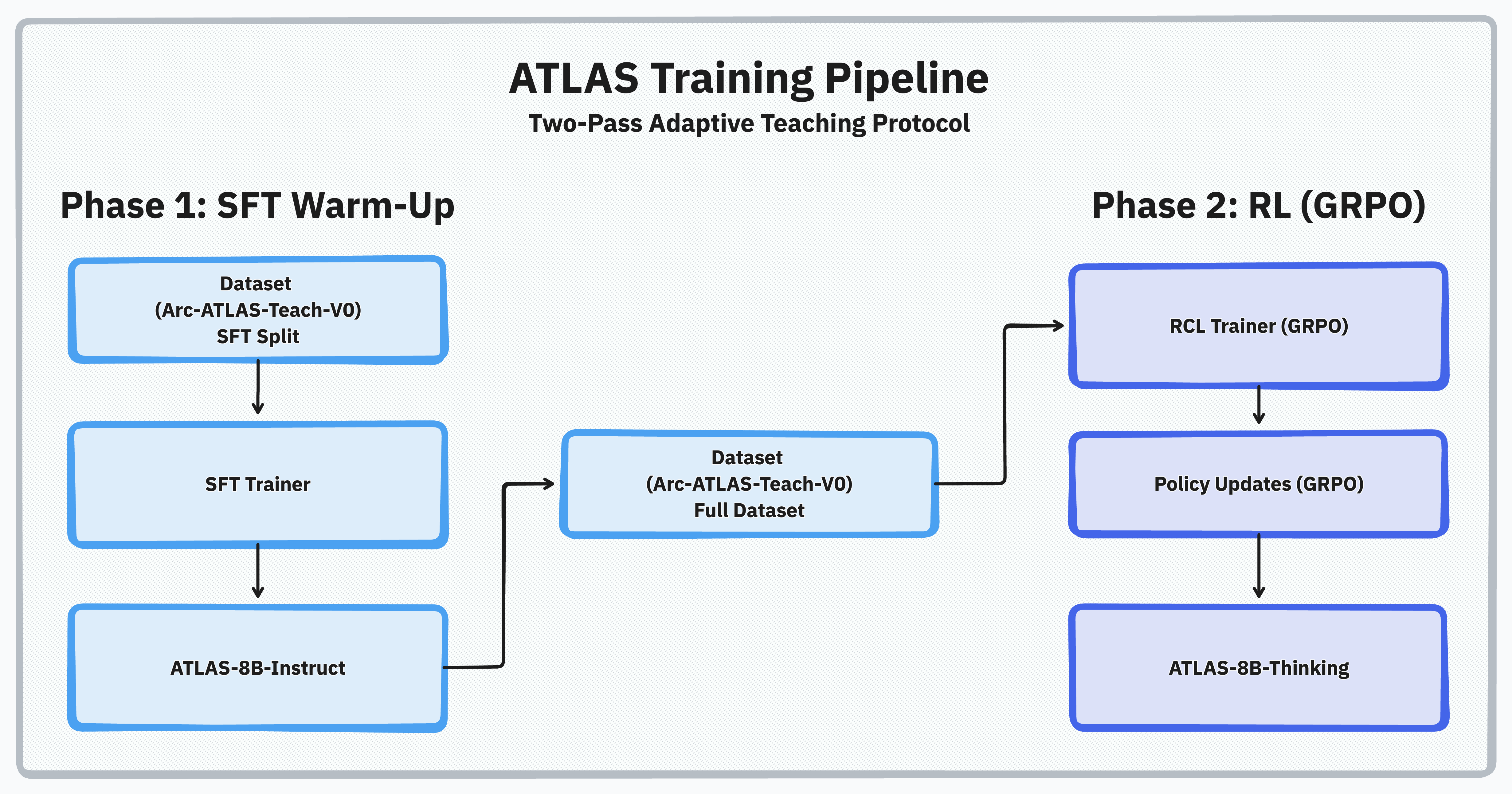
ATLAS provides specialized trainer classes for different training paradigms. Each trainer extends HuggingFace's base trainer with RL-specific capabilities.
 ## Typical Usage
```python title="Standard GRPO Training" theme={null}
from atlas_core.training.algorithms.grpo import GRPOTrainer
from atlas_core.training.algorithms.grpo_config import GRPOConfig
from atlas_core.reward.interpretation import RIMReward
# Minimal training arguments (TrainingArguments requires an output_dir)
grpo_args = GRPOConfig(
output_dir="./output/grpo",
model_name_or_path="Arc-Intelligence/ATLAS-8B-Thinking",
learning_rate=5e-6,
num_train_epochs=3,
per_device_train_batch_size=4,
gradient_accumulation_steps=4,
beta=0.04, # KL penalty
logging_steps=10,
)
reward = RIMReward(config_path="reward_system/interpretation.yaml")
trainer = GRPOTrainer(
model=grpo_args.model_name_or_path,
reward_funcs=reward,
args=grpo_args,
train_dataset=train_data,
eval_dataset=eval_data,
processing_class=tokenizer,
)
trainer.train()
trainer.save_model("./output/grpo/checkpoint-final")
```
```python title="Dual-Agent Teacher Training" theme={null}
from atlas_core.training.algorithms.teacher_trainers import TeacherGRPOTrainer
from atlas_core.training.algorithms.grpo_config import GRPOConfig
from atlas_core.reward.interpretation import RIMReward
teacher_args = GRPOConfig(
output_dir="./output/teacher-grpo",
model_name_or_path="Arc-Intelligence/ATLAS-8B-Thinking",
learning_rate=5e-6,
num_train_epochs=3,
per_device_train_batch_size=1,
gradient_accumulation_steps=8,
beta=0.04,
logging_steps=10,
)
reward = RIMReward(config_path="reward_system/interpretation_offline.yaml")
trainer = TeacherGRPOTrainer(
model=teacher_args.model_name_or_path,
reward_funcs=reward,
args=teacher_args,
train_dataset=train_data,
processing_class=tokenizer,
student_model="meta-llama/Llama-3.2-8B-Instruct",
)
trainer.train()
trainer.save_model("./output/teacher-grpo/checkpoint-final")
```
```python title="SFT Warmup" theme={null}
from trl import SFTConfig, SFTTrainer
# Supervised fine-tuning before RL
trainer = SFTTrainer(
model=model,
args=training_args,
train_dataset=sft_dataset,
tokenizer=tokenizer,
max_seq_length=2048
)
trainer.train()
```
## GRPOTrainer
Main trainer for Group Relative Policy Optimization.
### Class Overview
GRPOTrainer is the main trainer class for Group Relative Policy Optimization, extending the standard HuggingFace Trainer with reinforcement learning capabilities.
| Parameter | Type | Description |
| ----------------- | ---------------------- | ------------------------------- |
| `config` | GRPOConfig | Training configuration |
| `model` | PreTrainedModel | Model to train (policy network) |
| `ref_model` | PreTrainedModel | Reference model for KL penalty |
| `tokenizer` | PreTrainedTokenizer | Tokenizer for encoding/decoding |
| `train_dataset` | Dataset | Training data |
| `eval_dataset` | Dataset | Evaluation data |
| `reward_model` | PreTrainedModel | Optional external reward model |
| `compute_metrics` | Callable | Custom metrics function |
| `callbacks` | List\[TrainerCallback] | Training callbacks |
| `optimizers` | Tuple | Custom optimizer and scheduler |
**GRPO Training Loop**: Implements the complete reinforcement learning training process with policy gradient optimization and KL divergence constraints.
**Generation Support**: Supports both local generation and distributed generation via vLLM server integration.
**Memory Management**: Includes optimizations for training large models with gradient checkpointing and model offloading.
**Reward Composition**: Handles multiple reward functions (including optional RIM-based scoring) and reward weighting for complex optimization objectives.
**Implementation**: See `src/atlas_core/training/algorithms/grpo.py` for complete method signatures and implementation details.
Override these methods for custom behavior:
```python theme={null}
def on_epoch_begin(self):
"""Called at the beginning of each epoch"""
pass
def on_step_end(self, args, state, control, **kwargs):
"""Called at the end of each training step"""
# Log custom metrics
self.log({
"rewards/mean": self.current_rewards.mean(),
"kl_divergence": self.current_kl.mean()
})
def on_evaluate(self, args, state, control, metrics=None, **kwargs):
"""Called after evaluation"""
# Custom evaluation logic
pass
```
**Source**: `src/atlas_core/training/algorithms/grpo.py`
## TeacherGRPOTrainer
Specialized trainer for adaptive dual-agent teaching (student agent + verifying teacher).
### Class Overview
TeacherGRPOTrainer extends GRPOTrainer to implement the two-pass teaching protocol. From the actual source code (`src/atlas_core/training/algorithms/teacher_trainers.py`), this trainer:
* Inherits from both `GRPOTrainer` and `TeacherTrainer`
* Accepts `student_model` parameter in constructor
* Implements diagnostic probing and verifying-teacher guidance templates
* Manages both teacher and student models during training
### diagnostic\_probe()
Assess student capability:
```python theme={null}
def diagnostic_probe(
self,
task: str,
max_tokens: int = 50
) -> DiagnosticResult:
"""
Probe student understanding of given task
Args:
task: Task or problem statement to probe
max_tokens: Maximum tokens for probe response
Returns:
DiagnosticResult: Assessment containing:
- capability_level: Student capability (0.0-1.0)
- confidence_score: Confidence in assessment (0.0-1.0)
- identified_gaps: List of specific knowledge gaps
- response_quality: Quality metrics for student response
- probe_tokens: Number of tokens used in probe
Raises:
ValueError: If task is empty or max_tokens < 1
RuntimeError: If student model inference fails
TypeError: If task is not a string
Example:
result = trainer.diagnostic_probe("Solve: 2x + 5 = 11")
if result.capability_level < 0.3:
print("Student needs significant help")
"""
```
### generate\_guidance()
Create verifying-teacher guidance:
```python theme={null}
def generate_guidance(
self,
task: str,
diagnostic: DiagnosticResult,
max_tokens: int = 200
) -> str:
"""
Generate teaching guidance based on diagnosis
Args:
task: Original task or problem statement
diagnostic: Results from diagnostic_probe()
max_tokens: Maximum tokens for guidance response
Returns:
str: Tailored teaching guidance text
Format depends on capability_level:
- Low (0.0-0.3): Step-by-step walkthrough
- Medium (0.3-0.7): Hints and scaffolding
- High (0.7-1.0): Minimal guidance or verification
Raises:
ValueError: If max_tokens < 10 or diagnostic is None
RuntimeError: If teacher model fails to generate guidance
TypeError: If task is not a string
Example:
diagnostic = trainer.diagnostic_probe("Solve quadratic equation")
guidance = trainer.generate_guidance(
"Solve: x² - 5x + 6 = 0",
diagnostic,
max_tokens=150
)
print(f"Teaching guidance: {guidance}")
"""
```
### compute\_teaching\_reward()
Calculate teaching effectiveness:
```python theme={null}
def compute_teaching_reward(
self,
baseline_score: float,
enhanced_score: float,
teaching_length: int
) -> float:
"""
Compute reward for teaching quality
Args:
baseline_score: Student performance without guidance (0.0-1.0)
enhanced_score: Student performance with guidance (0.0-1.0)
teaching_length: Number of tokens in teaching guidance
Returns:
float: Teaching reward score
- Positive: Effective teaching (improvement achieved)
- Zero: No improvement or neutral
- Negative: Degraded performance (safety penalty)
Raises:
ValueError: If scores not in [0.0, 1.0] or teaching_length < 0
TypeError: If inputs are not numeric
Reward Components:
- Improvement bonus: (enhanced_score - baseline_score)
- Efficiency bonus: max(0, 1 - teaching_length / 200)
- Safety penalty: -2.0 if enhanced_score < baseline_score
Example:
reward = trainer.compute_teaching_reward(
baseline_score=0.6,
enhanced_score=0.8,
teaching_length=120
)
# reward ≈ 0.2 + 0.4 = 0.6 (improvement + efficiency)
"""
```
The two-pass protocol implementation:
```python theme={null}
def teaching_step(self, batch):
"""Execute one teaching interaction"""
# Phase 1: Diagnostic
diagnostics = []
for prompt in batch["prompts"]:
diag = self.diagnostic_probe(prompt)
diagnostics.append(diag)
# Phase 2: Guidance generation
guidances = []
for prompt, diag in zip(batch["prompts"], diagnostics):
guidance = self.generate_guidance(prompt, diag)
guidances.append(guidance)
# Phase 3: Student enhancement
baseline_responses = self.student_model.generate(batch["prompts"])
enhanced_responses = self.student_model.generate(
batch["prompts"],
guidance=guidances
)
# Phase 4: Reward computation
rewards = []
for base, enh, guid in zip(baseline_responses, enhanced_responses, guidances):
reward = self.compute_teaching_reward(
self.score(base),
self.score(enh),
len(guid)
)
rewards.append(reward)
return rewards
```
### Reward System Integration
TeacherGRPOTrainer expects `reward_funcs` to supply the evaluation signal. When you pass an instance of `RIMReward`, each call returns both the aggregated reward and an information dictionary containing per-judge scores, principles, and rationales. The trainer logs these details under `rim_rewards` and `rim_explanations`, making it possible to inspect accuracy, helpfulness, process, and diagnostic scores separately. To switch configurations during an experiment, update the Hydra override so that `RIMReward` loads either `reward_system/interpretation.yaml` or `reward_system/interpretation_offline.yaml`. The trainer does not need any code changes when you modify judge prompts, thresholds, or model choices.
**Source**: `src/atlas_core/training/algorithms/teacher_trainers.py`
## SFTTrainer
Supervised fine-tuning trainer for warmup before RL.
### Constructor
```python theme={null}
class SFTTrainer(Trainer):
def __init__(
self,
model: PreTrainedModel,
args: TrainingArguments,
train_dataset: Dataset,
eval_dataset: Optional[Dataset] = None,
tokenizer: PreTrainedTokenizer,
data_collator: Optional[DataCollator] = None,
max_seq_length: int = 2048,
packing: bool = False,
formatting_func: Optional[Callable] = None,
):
```
* **Sequence packing**: Efficient batching of variable-length sequences
* **Custom formatting**: Apply templates to raw data
* **Gradient accumulation**: Handle large effective batch sizes
* **Mixed precision**: FP16/BF16 training support
### format\_dataset()
Prepare data for training:
```python theme={null}
def format_dataset(self, dataset):
"""Format dataset for SFT training"""
def formatting_func(example):
# Apply chat template
messages = example["messages"]
text = self.tokenizer.apply_chat_template(
messages,
tokenize=False
)
return {"text": text}
return dataset.map(formatting_func)
```
### pack\_sequences()
Efficient sequence packing:
```python theme={null}
def pack_sequences(self, tokenized_dataset):
"""Pack multiple sequences into single training example"""
# Implementation for efficient GPU utilization
```
**Source**: TRL `SFTTrainer`
## Custom Trainer Implementation
Create your own trainer by extending base classes:
```python theme={null}
from atlas_core.training.algorithms.grpo import GRPOTrainer
import torch
class CustomRewardTrainer(GRPOTrainer):
"""Custom trainer with modified reward computation"""
def compute_rewards(self, completions, prompts):
"""Override reward computation"""
rewards = []
for completion, prompt in zip(completions, prompts):
# Custom reward logic
reward = self.custom_reward_function(completion, prompt)
rewards.append(reward)
return torch.tensor(rewards)
def custom_reward_function(self, completion, prompt):
"""Implement domain-specific rewards"""
# Example: Length penalty
length_penalty = min(1.0, len(completion) / 500)
# Example: Quality score
quality = self.quality_model(completion)
return quality * length_penalty
```
## Callbacks and Monitoring
### Available Callbacks
```python theme={null}
from transformers import EarlyStoppingCallback
from transformers.integrations import TensorBoardCallback, WandbCallback
# Configure callbacks
callbacks = [
WandbCallback(
project="atlas-training",
name="experiment-1"
),
EarlyStoppingCallback(
early_stopping_patience=3,
early_stopping_threshold=0.001
)
]
trainer = GRPOTrainer(
config=config,
callbacks=callbacks
)
```
### Custom Metrics
```python theme={null}
def compute_metrics(eval_predictions):
"""Custom metrics computation"""
predictions, labels = eval_predictions
return {
"accuracy": accuracy_score(labels, predictions),
"perplexity": perplexity(predictions),
"diversity": diversity_score(predictions),
"safety_rate": safety_check(predictions)
}
trainer = GRPOTrainer(
config=config,
compute_metrics=compute_metrics
)
```
## Distributed Training
### Multi-GPU Setup
```python theme={null}
from atlas_core.training.algorithms.grpo import GRPOTrainer
from accelerate import Accelerator
accelerator = Accelerator()
trainer = GRPOTrainer(
config=config,
model=model,
accelerator=accelerator
)
# Trainer automatically handles distributed setup
trainer.train()
```
### DeepSpeed Integration
Atlas Core relies on Accelerate configs to enable DeepSpeed. Use one of the presets in `accelerate/`:
```bash theme={null}
# Default zero3
accelerate launch --config_file accelerate/deepspeed_zero3.yaml \
-m atlas_core.cli.train recipe@_global_=teacher_rcl
# CPU offload
accelerate launch --config_file accelerate/deepspeed_zero3_cpu_offloading.yaml \
-m atlas_core.cli.train recipe@_global_=teacher_rcl
```
## Implementation Notes
ATLAS trainers extend standard HuggingFace Trainer classes with RL-specific functionality. The implementation details can be found in:
* `src/atlas_core/training/algorithms/grpo.py` - Main GRPO trainer implementation
* `src/atlas_core/training/algorithms/teacher_trainers.py` - Teacher-student training logic
* `src/atlas_core/training/algorithms/grpo_config.py` - Configuration parameters
## Troubleshooting
**Problem**: CUDA OOM during training
**Solutions**:
```python theme={null}
# Reduce batch size
config.per_device_train_batch_size = 1
config.gradient_accumulation_steps = 32
# Enable gradient checkpointing
config.gradient_checkpointing = True
# Use mixed precision
config.fp16 = True
```
**Problem**: Training is slower than expected
**Solutions**:
```python theme={null}
# Enable compilation (PyTorch 2.0+)
model = torch.compile(model)
# Use Flash Attention
config.attn_implementation = "flash_attention_2"
# Optimize data loading
config.dataloader_num_workers = 4
config.dataloader_pin_memory = True
```
**Problem**: Loss spikes or NaN values
**Solutions**:
```python theme={null}
# Reduce learning rate
config.learning_rate = 1e-6
# Increase KL penalty
config.beta = 0.1
# Clip gradients
config.max_grad_norm = 0.5
```
## Next Steps
Step-by-step training tutorial
Production-ready MCP integration example
## Typical Usage
```python title="Standard GRPO Training" theme={null}
from atlas_core.training.algorithms.grpo import GRPOTrainer
from atlas_core.training.algorithms.grpo_config import GRPOConfig
from atlas_core.reward.interpretation import RIMReward
# Minimal training arguments (TrainingArguments requires an output_dir)
grpo_args = GRPOConfig(
output_dir="./output/grpo",
model_name_or_path="Arc-Intelligence/ATLAS-8B-Thinking",
learning_rate=5e-6,
num_train_epochs=3,
per_device_train_batch_size=4,
gradient_accumulation_steps=4,
beta=0.04, # KL penalty
logging_steps=10,
)
reward = RIMReward(config_path="reward_system/interpretation.yaml")
trainer = GRPOTrainer(
model=grpo_args.model_name_or_path,
reward_funcs=reward,
args=grpo_args,
train_dataset=train_data,
eval_dataset=eval_data,
processing_class=tokenizer,
)
trainer.train()
trainer.save_model("./output/grpo/checkpoint-final")
```
```python title="Dual-Agent Teacher Training" theme={null}
from atlas_core.training.algorithms.teacher_trainers import TeacherGRPOTrainer
from atlas_core.training.algorithms.grpo_config import GRPOConfig
from atlas_core.reward.interpretation import RIMReward
teacher_args = GRPOConfig(
output_dir="./output/teacher-grpo",
model_name_or_path="Arc-Intelligence/ATLAS-8B-Thinking",
learning_rate=5e-6,
num_train_epochs=3,
per_device_train_batch_size=1,
gradient_accumulation_steps=8,
beta=0.04,
logging_steps=10,
)
reward = RIMReward(config_path="reward_system/interpretation_offline.yaml")
trainer = TeacherGRPOTrainer(
model=teacher_args.model_name_or_path,
reward_funcs=reward,
args=teacher_args,
train_dataset=train_data,
processing_class=tokenizer,
student_model="meta-llama/Llama-3.2-8B-Instruct",
)
trainer.train()
trainer.save_model("./output/teacher-grpo/checkpoint-final")
```
```python title="SFT Warmup" theme={null}
from trl import SFTConfig, SFTTrainer
# Supervised fine-tuning before RL
trainer = SFTTrainer(
model=model,
args=training_args,
train_dataset=sft_dataset,
tokenizer=tokenizer,
max_seq_length=2048
)
trainer.train()
```
## GRPOTrainer
Main trainer for Group Relative Policy Optimization.
### Class Overview
GRPOTrainer is the main trainer class for Group Relative Policy Optimization, extending the standard HuggingFace Trainer with reinforcement learning capabilities.
| Parameter | Type | Description |
| ----------------- | ---------------------- | ------------------------------- |
| `config` | GRPOConfig | Training configuration |
| `model` | PreTrainedModel | Model to train (policy network) |
| `ref_model` | PreTrainedModel | Reference model for KL penalty |
| `tokenizer` | PreTrainedTokenizer | Tokenizer for encoding/decoding |
| `train_dataset` | Dataset | Training data |
| `eval_dataset` | Dataset | Evaluation data |
| `reward_model` | PreTrainedModel | Optional external reward model |
| `compute_metrics` | Callable | Custom metrics function |
| `callbacks` | List\[TrainerCallback] | Training callbacks |
| `optimizers` | Tuple | Custom optimizer and scheduler |
**GRPO Training Loop**: Implements the complete reinforcement learning training process with policy gradient optimization and KL divergence constraints.
**Generation Support**: Supports both local generation and distributed generation via vLLM server integration.
**Memory Management**: Includes optimizations for training large models with gradient checkpointing and model offloading.
**Reward Composition**: Handles multiple reward functions (including optional RIM-based scoring) and reward weighting for complex optimization objectives.
**Implementation**: See `src/atlas_core/training/algorithms/grpo.py` for complete method signatures and implementation details.
Override these methods for custom behavior:
```python theme={null}
def on_epoch_begin(self):
"""Called at the beginning of each epoch"""
pass
def on_step_end(self, args, state, control, **kwargs):
"""Called at the end of each training step"""
# Log custom metrics
self.log({
"rewards/mean": self.current_rewards.mean(),
"kl_divergence": self.current_kl.mean()
})
def on_evaluate(self, args, state, control, metrics=None, **kwargs):
"""Called after evaluation"""
# Custom evaluation logic
pass
```
**Source**: `src/atlas_core/training/algorithms/grpo.py`
## TeacherGRPOTrainer
Specialized trainer for adaptive dual-agent teaching (student agent + verifying teacher).
### Class Overview
TeacherGRPOTrainer extends GRPOTrainer to implement the two-pass teaching protocol. From the actual source code (`src/atlas_core/training/algorithms/teacher_trainers.py`), this trainer:
* Inherits from both `GRPOTrainer` and `TeacherTrainer`
* Accepts `student_model` parameter in constructor
* Implements diagnostic probing and verifying-teacher guidance templates
* Manages both teacher and student models during training
### diagnostic\_probe()
Assess student capability:
```python theme={null}
def diagnostic_probe(
self,
task: str,
max_tokens: int = 50
) -> DiagnosticResult:
"""
Probe student understanding of given task
Args:
task: Task or problem statement to probe
max_tokens: Maximum tokens for probe response
Returns:
DiagnosticResult: Assessment containing:
- capability_level: Student capability (0.0-1.0)
- confidence_score: Confidence in assessment (0.0-1.0)
- identified_gaps: List of specific knowledge gaps
- response_quality: Quality metrics for student response
- probe_tokens: Number of tokens used in probe
Raises:
ValueError: If task is empty or max_tokens < 1
RuntimeError: If student model inference fails
TypeError: If task is not a string
Example:
result = trainer.diagnostic_probe("Solve: 2x + 5 = 11")
if result.capability_level < 0.3:
print("Student needs significant help")
"""
```
### generate\_guidance()
Create verifying-teacher guidance:
```python theme={null}
def generate_guidance(
self,
task: str,
diagnostic: DiagnosticResult,
max_tokens: int = 200
) -> str:
"""
Generate teaching guidance based on diagnosis
Args:
task: Original task or problem statement
diagnostic: Results from diagnostic_probe()
max_tokens: Maximum tokens for guidance response
Returns:
str: Tailored teaching guidance text
Format depends on capability_level:
- Low (0.0-0.3): Step-by-step walkthrough
- Medium (0.3-0.7): Hints and scaffolding
- High (0.7-1.0): Minimal guidance or verification
Raises:
ValueError: If max_tokens < 10 or diagnostic is None
RuntimeError: If teacher model fails to generate guidance
TypeError: If task is not a string
Example:
diagnostic = trainer.diagnostic_probe("Solve quadratic equation")
guidance = trainer.generate_guidance(
"Solve: x² - 5x + 6 = 0",
diagnostic,
max_tokens=150
)
print(f"Teaching guidance: {guidance}")
"""
```
### compute\_teaching\_reward()
Calculate teaching effectiveness:
```python theme={null}
def compute_teaching_reward(
self,
baseline_score: float,
enhanced_score: float,
teaching_length: int
) -> float:
"""
Compute reward for teaching quality
Args:
baseline_score: Student performance without guidance (0.0-1.0)
enhanced_score: Student performance with guidance (0.0-1.0)
teaching_length: Number of tokens in teaching guidance
Returns:
float: Teaching reward score
- Positive: Effective teaching (improvement achieved)
- Zero: No improvement or neutral
- Negative: Degraded performance (safety penalty)
Raises:
ValueError: If scores not in [0.0, 1.0] or teaching_length < 0
TypeError: If inputs are not numeric
Reward Components:
- Improvement bonus: (enhanced_score - baseline_score)
- Efficiency bonus: max(0, 1 - teaching_length / 200)
- Safety penalty: -2.0 if enhanced_score < baseline_score
Example:
reward = trainer.compute_teaching_reward(
baseline_score=0.6,
enhanced_score=0.8,
teaching_length=120
)
# reward ≈ 0.2 + 0.4 = 0.6 (improvement + efficiency)
"""
```
The two-pass protocol implementation:
```python theme={null}
def teaching_step(self, batch):
"""Execute one teaching interaction"""
# Phase 1: Diagnostic
diagnostics = []
for prompt in batch["prompts"]:
diag = self.diagnostic_probe(prompt)
diagnostics.append(diag)
# Phase 2: Guidance generation
guidances = []
for prompt, diag in zip(batch["prompts"], diagnostics):
guidance = self.generate_guidance(prompt, diag)
guidances.append(guidance)
# Phase 3: Student enhancement
baseline_responses = self.student_model.generate(batch["prompts"])
enhanced_responses = self.student_model.generate(
batch["prompts"],
guidance=guidances
)
# Phase 4: Reward computation
rewards = []
for base, enh, guid in zip(baseline_responses, enhanced_responses, guidances):
reward = self.compute_teaching_reward(
self.score(base),
self.score(enh),
len(guid)
)
rewards.append(reward)
return rewards
```
### Reward System Integration
TeacherGRPOTrainer expects `reward_funcs` to supply the evaluation signal. When you pass an instance of `RIMReward`, each call returns both the aggregated reward and an information dictionary containing per-judge scores, principles, and rationales. The trainer logs these details under `rim_rewards` and `rim_explanations`, making it possible to inspect accuracy, helpfulness, process, and diagnostic scores separately. To switch configurations during an experiment, update the Hydra override so that `RIMReward` loads either `reward_system/interpretation.yaml` or `reward_system/interpretation_offline.yaml`. The trainer does not need any code changes when you modify judge prompts, thresholds, or model choices.
**Source**: `src/atlas_core/training/algorithms/teacher_trainers.py`
## SFTTrainer
Supervised fine-tuning trainer for warmup before RL.
### Constructor
```python theme={null}
class SFTTrainer(Trainer):
def __init__(
self,
model: PreTrainedModel,
args: TrainingArguments,
train_dataset: Dataset,
eval_dataset: Optional[Dataset] = None,
tokenizer: PreTrainedTokenizer,
data_collator: Optional[DataCollator] = None,
max_seq_length: int = 2048,
packing: bool = False,
formatting_func: Optional[Callable] = None,
):
```
* **Sequence packing**: Efficient batching of variable-length sequences
* **Custom formatting**: Apply templates to raw data
* **Gradient accumulation**: Handle large effective batch sizes
* **Mixed precision**: FP16/BF16 training support
### format\_dataset()
Prepare data for training:
```python theme={null}
def format_dataset(self, dataset):
"""Format dataset for SFT training"""
def formatting_func(example):
# Apply chat template
messages = example["messages"]
text = self.tokenizer.apply_chat_template(
messages,
tokenize=False
)
return {"text": text}
return dataset.map(formatting_func)
```
### pack\_sequences()
Efficient sequence packing:
```python theme={null}
def pack_sequences(self, tokenized_dataset):
"""Pack multiple sequences into single training example"""
# Implementation for efficient GPU utilization
```
**Source**: TRL `SFTTrainer`
## Custom Trainer Implementation
Create your own trainer by extending base classes:
```python theme={null}
from atlas_core.training.algorithms.grpo import GRPOTrainer
import torch
class CustomRewardTrainer(GRPOTrainer):
"""Custom trainer with modified reward computation"""
def compute_rewards(self, completions, prompts):
"""Override reward computation"""
rewards = []
for completion, prompt in zip(completions, prompts):
# Custom reward logic
reward = self.custom_reward_function(completion, prompt)
rewards.append(reward)
return torch.tensor(rewards)
def custom_reward_function(self, completion, prompt):
"""Implement domain-specific rewards"""
# Example: Length penalty
length_penalty = min(1.0, len(completion) / 500)
# Example: Quality score
quality = self.quality_model(completion)
return quality * length_penalty
```
## Callbacks and Monitoring
### Available Callbacks
```python theme={null}
from transformers import EarlyStoppingCallback
from transformers.integrations import TensorBoardCallback, WandbCallback
# Configure callbacks
callbacks = [
WandbCallback(
project="atlas-training",
name="experiment-1"
),
EarlyStoppingCallback(
early_stopping_patience=3,
early_stopping_threshold=0.001
)
]
trainer = GRPOTrainer(
config=config,
callbacks=callbacks
)
```
### Custom Metrics
```python theme={null}
def compute_metrics(eval_predictions):
"""Custom metrics computation"""
predictions, labels = eval_predictions
return {
"accuracy": accuracy_score(labels, predictions),
"perplexity": perplexity(predictions),
"diversity": diversity_score(predictions),
"safety_rate": safety_check(predictions)
}
trainer = GRPOTrainer(
config=config,
compute_metrics=compute_metrics
)
```
## Distributed Training
### Multi-GPU Setup
```python theme={null}
from atlas_core.training.algorithms.grpo import GRPOTrainer
from accelerate import Accelerator
accelerator = Accelerator()
trainer = GRPOTrainer(
config=config,
model=model,
accelerator=accelerator
)
# Trainer automatically handles distributed setup
trainer.train()
```
### DeepSpeed Integration
Atlas Core relies on Accelerate configs to enable DeepSpeed. Use one of the presets in `accelerate/`:
```bash theme={null}
# Default zero3
accelerate launch --config_file accelerate/deepspeed_zero3.yaml \
-m atlas_core.cli.train recipe@_global_=teacher_rcl
# CPU offload
accelerate launch --config_file accelerate/deepspeed_zero3_cpu_offloading.yaml \
-m atlas_core.cli.train recipe@_global_=teacher_rcl
```
## Implementation Notes
ATLAS trainers extend standard HuggingFace Trainer classes with RL-specific functionality. The implementation details can be found in:
* `src/atlas_core/training/algorithms/grpo.py` - Main GRPO trainer implementation
* `src/atlas_core/training/algorithms/teacher_trainers.py` - Teacher-student training logic
* `src/atlas_core/training/algorithms/grpo_config.py` - Configuration parameters
## Troubleshooting
**Problem**: CUDA OOM during training
**Solutions**:
```python theme={null}
# Reduce batch size
config.per_device_train_batch_size = 1
config.gradient_accumulation_steps = 32
# Enable gradient checkpointing
config.gradient_checkpointing = True
# Use mixed precision
config.fp16 = True
```
**Problem**: Training is slower than expected
**Solutions**:
```python theme={null}
# Enable compilation (PyTorch 2.0+)
model = torch.compile(model)
# Use Flash Attention
config.attn_implementation = "flash_attention_2"
# Optimize data loading
config.dataloader_num_workers = 4
config.dataloader_pin_memory = True
```
**Problem**: Loss spikes or NaN values
**Solutions**:
```python theme={null}
# Reduce learning rate
config.learning_rate = 1e-6
# Increase KL penalty
config.beta = 0.1
# Clip gradients
config.max_grad_norm = 0.5
```
## Next Steps
Step-by-step training tutorial
Production-ready MCP integration example